
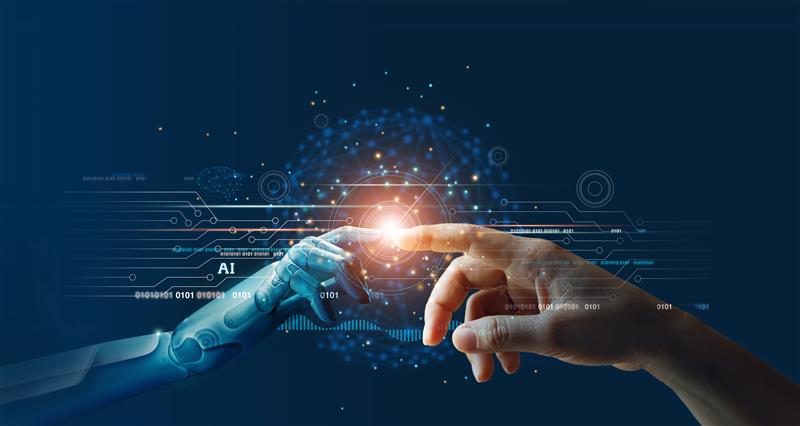
Between the code and connection, the difference is not the algorithm, but the human strategy.
Artificial intelligence has changed how businesses approach marketing. Far from replacing human creativity, it is a turbocharge for efficiency, speed, and accuracy, enabling brands to create highly personalized content at a previously unattainable scale.
This shift is structural. According to Gartner, AI adoption by marketing professionals is expected to quadruple by 2026, reaching 40% of the content produced. This growth is due to the need to optimize content generation and personalize the customer experience, requiring businesses to use technology to create more intelligently and with less effort.
AI as the Catalyst for Content Creation
The biggest impact of AI on marketing is its ability to accelerate production and optimize the relevance of what is created. The technology takes over heavy tasks, freeing up the creative team to focus on what they do best: strategy and original ideas. It is projected that by 2026, 90% of online content will be created by generative AI. This includes everything from email marketing texts and ad copies to the generation of graphic assets.
Meta, for example, plans to fully automate advertising creation with AI by the end of 2026. This means that the machine will be capable of generating the creative (image, video, and text) and defining the ideal targeting from a basic brief. The authority of the marketing team will then lie in their ability to guide the machine so that the creative result faithfully reflects the brand’s tone, values, and authenticity.
Personalization at Scale: The Secret to Connecting, Not Just Selling
The primary challenge in marketing has always been how to personalize a message for millions without losing production scale. AI finally solves this problem by transforming simple consumer data into ultra-segmented content.
The technology enables “mass personalization,” where AI analyzes individual behavior in real time to shape ads and offers. Tools can already automatically create ultra-segmented audiences, ensuring that two users on the same platform see different versions of the same ad, depending on their interaction history.
Despite the excitement around personalization, AI maturity in Brazil is still a challenge. While it is the number one priority for 2026, most companies still face organizational and human challenges, such as the absence of a clear strategy for using technology and the lack of technical training within teams.
Human Strategy Guarantees Creative Authenticity
While AI can generate efficient, targeted content, the central role of marketing is to ensure authenticity and purpose. It is human strategy that injects brand vision, sensitivity, and the insight factor that no machine can replicate. This is fundamentally the market differentiator your company must strive for.
It’s not enough to have the tool; it’s about knowing how to guide it in the best way.
While most companies focus solely on producing more content with AI, the true market leader uses strategic professionals to transform it into an engine for innovation. Companies that will lead the market will be those that use AI to:
- Accelerate ideation – quickly generate hundreds of variations of ideas for humans to select the most authentic ones.
- Optimize testing – run A/B/C tests in real-time to understand which creative works best.
- Measure impact – turn large volumes of performance data into actionable insights for the next creative round.
The key to success lies in mastering strategy to guide the technology. This is what Michele Quiarato, Copywriter at Ideatore Americas, emphasizes:
“I won’t deny that AI does the heavy lifting of generating lots of ideas, and that’s great. But the turning point is us, because we are the ones who do the ‘polishing,’ who add emotion and the exact tone of voice of the brand, ensuring that the message resonates with the audience rather than just being delivered. It’s our sensitivity that transforms the rational text of the machine into a human and strategic connection.”
The machine is an ally of creative efficiency. However, the true differentiator lies in the professionals who can translate data into strategic narratives, ensuring that marketing is not just automated but genuinely meaningful for the consumer.
And this is the difference between those who use technology and those who truly know how to achieve results with it.