

Discover how GEO can give your SEO strategy an edge for smarter digital presence
In recent years, the world of digital optimization has undergone a significant transformation with the advancement of Artificial Intelligence (AI). While traditional SEO (Search Engine Optimization) remains the backbone of digital marketing strategies, a new subfield has emerged: Generative Engine Optimization (GEO), which focuses on optimizing content for generative AI systems like ChatGPT.
SEO: the foundation of digital optimization
SEO is the practice of optimizing websites and content to improve their ranking on search engine results pages (SERPs). The main goal of SEO is to increase a website’s organic visibility by attracting quality traffic through relevant keywords, high-authority backlinks, and an optimized content structure.
Key SEO practices include:
Keyword research: identifying relevant terms users are searching for and optimizing content for those keywords.
On-page SEO: improving the internal structure of content, including headers, subheaders, optimized images, and metadata.
Quality backlinks: earning links from authoritative websites, which helps boost a site’s credibility and domain authority.
Technical SEO: improving technical aspects of a website, such as loading speed, security (HTTPS), and responsive design.
GEO: optimization for generative AI
GEO is a relatively new but essential technique focused on optimizing content so that it can be directly referenced by generative AI systems. Generative AI such as virtual assistants and tools based on machine learning generates responses based on the information it is trained on or has access to. The purpose of GEO is to ensure your content is recognized, extracted, and used by AIs when generating responses or providing information.
How GEO works:
AI-focused optimization: GEO adapts content to be easily processed and used by AI, emphasizing informational quality and contextual relevance.
Data structuring: a solid GEO strategy ensures that data is organized in a way that AI algorithms can understand and utilize effectively.
High-quality, relevant content: GEO aims to create content that’s not only useful but also well-structured and clear, so that AI systems can extract it with ease.
SEO vs. GEO: what’s the difference?
While both aim to increase content visibility, their objectives and approaches differ. SEO ensures content appears in search engine results like Google, while GEO focuses on optimizing content so that it is directly referenced in AI-generated responses.
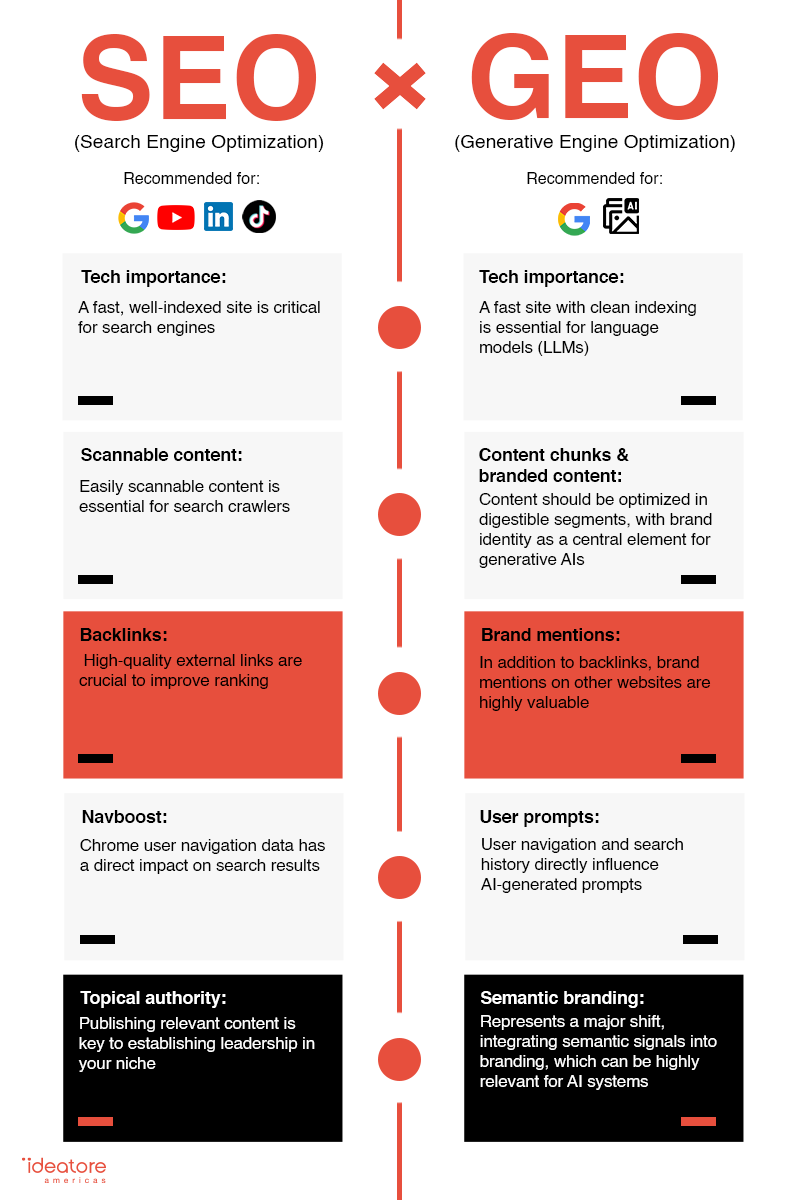
The importance of GEO in the future of digital optimization
GEO is emerging as the evolution of SEO, enabling digital content not only to appear in search results but also to be intelligently used by generative AI systems. To ensure your content is discoverable and relevant both for search engines and AI assistants, it’s essential to combine SEO best practices with GEO techniques.
By mastering both strategies, your business will be well-positioned to thrive in the evolving digital landscape and stand out in AI-generated responses.